
GEO for E-commerce: How to Get Products Recommended by AI
GEO for e-commerce (Generative Engine Optimization, the practice of making content retrievable and citable by AI) helps products get recommended by structuring product data, reviews, rich media, and category coverage so ChatGPT, Perplexity, Gemini, and Google AI Overviews can understand and trust them. The goal is recommendation eligibility, not just rankings.
Last updated: March 2026
Answer Capsule: How GEO Helps E-commerce Products Get Recommended by AI
GEO for e-commerce works when product pages and category pages become “easy for AI to retrieve, verify, and cite.” In practice, that means: (1) complete attributes (price, sizing, compatibility), (2) consistent availability signals, (3) credible reviews across trusted platforms, and (4) rich media that supports decision-making. Adobe Analytics data cited by Flatline Agency reports traffic to retail sites from generative AI sources grew over 1,200% in the last year (2025), which is why recommendation visibility is now a revenue lever, not a branding nice-to-have (Flatline Agency).

Oltre AI focuses on closing the AI Citation Gap by tracking which products show up for real shopping prompts and which competitors are being cited instead. If you need foundational context first, start with understanding GEO versus SEO for e-commerce—then use the playbook below to operationalize GEO across content, data, and trust signals.
What GEO for E-commerce Is and How AI Shopping Assistants Choose Products
GEO for e-commerce (Generative Engine Optimization applied to product discovery) is the set of content, data, and trust improvements that make a product eligible to be recommended inside AI shopping assistants (chat interfaces that search, synthesize, and suggest products). Unlike classic Google Search ranking, AI systems often cite chunks—a spec table, a review summary, a returns policy—rather than “the whole page.”

AI recommendations are driven by query fan-out (the system breaks one shopping question into many sub-questions). A prompt like “best running shoes for flat feet under $150” typically fans out into price, fit, reviews, return policy, availability, and brand trust—then the model synthesizes what it can verify. That’s why top-10 Google rankings alone are no longer enough: only 17–38% of Google AI Overview citations come from top-10 organic results (Ahrefs/BrightEdge, Feb 2026, cited by BigCommerce).
“GEO is about optimizing content to boost its visibility in AI-driven search results, much like SEO does for traditional search rankings. In practical terms, GEO can involve adding structured data (schema), clear product descriptions, FAQ sections, and customer reviews so that AI models can understand and cite your content.”
| Platform | Likely product inputs | Citation behavior | Optimization priority |
|---|---|---|---|
| ChatGPT | Web pages, reviews, comparison content | Selective citations | Front-loaded product summaries |
| Perplexity | Fresh pages + community sources | Citation-heavy | Update cadence + citable snippets |
| Gemini | Google Search + rich media | Often cites trusted sources | Multimodal + semantic completeness |
| Google AI Overviews | Fan-out results + YouTube | Multi-link citations | Coverage across sub-queries |
For deeper platform tactics, Oltre AI maintains guides on how to get cited by ChatGPT for e-commerce content and how to appear in Google AI Overviews for e-commerce.
5 Strategies to Get Your Products Recommended by AI
To get products recommended by AI, e-commerce teams need to improve retrievability (can the model find it), verifiability (can the model trust it), and extractability (can the model cite it). The five strategies below map directly to how ChatGPT, Perplexity, Gemini, and Google AI Overviews assemble shopping answers.

Practitioner note (Oltre AI): In audits, the fastest wins usually come from fixing the top 20% of SKUs that drive most revenue—because AI assistants tend to recommend “best-known, best-documented” products first.
1. Optimize Product Content
AI systems need detailed information to make confident recommendations. Thin product descriptions won’t get cited.
For each product, include:
- Comprehensive specifications (dimensions, materials, compatibility)
- Clear benefit statements (not just features)
- Use case descriptions (“perfect for...”)
- Honest comparison to alternatives
- Pros and cons (yes, including cons, since it builds trust)
Structure for AI parsing:
- Use clear headings and bullet points
- Include a product summary at the top (40–75 words)
- Present specs in scannable format
- Implement Product schema markup (Schema.org, the standard vocabulary for structured data)
2. Build Review Presence
Reviews are a primary signal for AI product recommendations. Products without reviews rarely get recommended.
| Platform | Priority | Notes |
|---|---|---|
| Google Reviews | High | Visible across Google ecosystem |
| Amazon | High | For Amazon sellers, essential |
| Industry-specific sites | High | Varies by category |
| Your own site | Medium | Verified reviews add credibility |
Review optimization:
- Actively encourage customers to leave reviews
- Respond to reviews (positive AND negative)
- Include diverse review perspectives
- Never fake or inappropriately incentivize reviews
3. Create Buying Guides
AI systems often draw from buying guides when making recommendations. These are high-value content assets. For Perplexity (a citation-first AI search engine), freshness matters: keep prices and model-year references updated (2026 cadence) and publish clear comparison criteria. For more on platform behavior, see Perplexity SEO optimization techniques.
“Best [Product] for [Use Case]” matches how users actually ask AI for recommendations. Examples: “Best running shoes for flat feet” or “Best laptops for video editing.”
“How to Choose a [Product]” helps users understand what to look for. This positions you as an authority and gets cited when AI explains decision criteria.
“[Product] Buyer’s Guide” provides comprehensive coverage of everything a buyer needs to know. Great for capturing long-tail queries.
“[Product A] vs [Product B]” comparison content is heavily used by AI when users ask about alternatives. Be fair and balanced.
Guide optimization:
- Be genuinely helpful, not just promotional
- Include multiple options (not just your products)
- Provide clear recommendation criteria
- Update regularly as products and prices change
- Add a short product demo video or YouTube embed when it reduces buyer uncertainty (e.g., fit, assembly, sound quality)
4. Ensure Presence on Comparison Sites
AI systems heavily rely on comparison sites and listicles for product recommendations.
Actions:
- Ensure inclusion on relevant “best of” lists
- Submit products to comparison sites in your category
- Maintain accurate listings across all platforms
- Monitor competitor placements
5. Optimize for Specific Queries
Users ask specific questions. Create content that answers them directly.
| Query Pattern | Content to Create |
|---|---|
| “Best [product] under [$price]” | Price-tiered recommendations |
| “Best [product] for [specific use]” | Use-case specific guides |
| “[Product A] vs [Product B]” | Direct comparison pages |
| “Is [product] worth it?” | Value analysis content |
To go deeper on platform-specific citation behavior, use best practices to get cited by Gemini AI and generative engine optimization strategies for AI recommendations.
How AI Shopping Assistants Compare When Recommending Products
AI shopping assistants differ less in “secret algorithms” and more in what they can reliably retrieve, verify, and cite. The safest strategy is to optimize for trust + completeness across platforms, because recommendation logic changes frequently (especially for shopping surfaces).

| Assistant | Typical product inputs | Freshness sensitivity | Reviews | Schema | Video/YouTube | Best move |
|---|---|---|---|---|---|---|
| ChatGPT | Web + comparison content | Medium | High trust signal | Helpful | Medium | Strong 40–75 word summaries |
| Perplexity | Fresh pages + community | Very high | High | Helpful | Low–medium | Update guides monthly |
| Gemini | Google Search ecosystem | High | High | High | Very high | Multimodal product pages |
| Google AI Overviews | Fan-out SERP + YouTube | High | High | High | Very high | Cover sub-queries with category hubs |
Two practical takeaways: Perplexity rewards fresh, citable snippets, while Google AI Overviews and Gemini reward semantic completeness and multimodal signals. ChatGPT is selective with citations, so front-loaded, extractable product copy matters. If you’re building one playbook, prioritize “works everywhere” fundamentals before platform tweaks.
Technical Implementation for AI-Readable Product and Category Pages
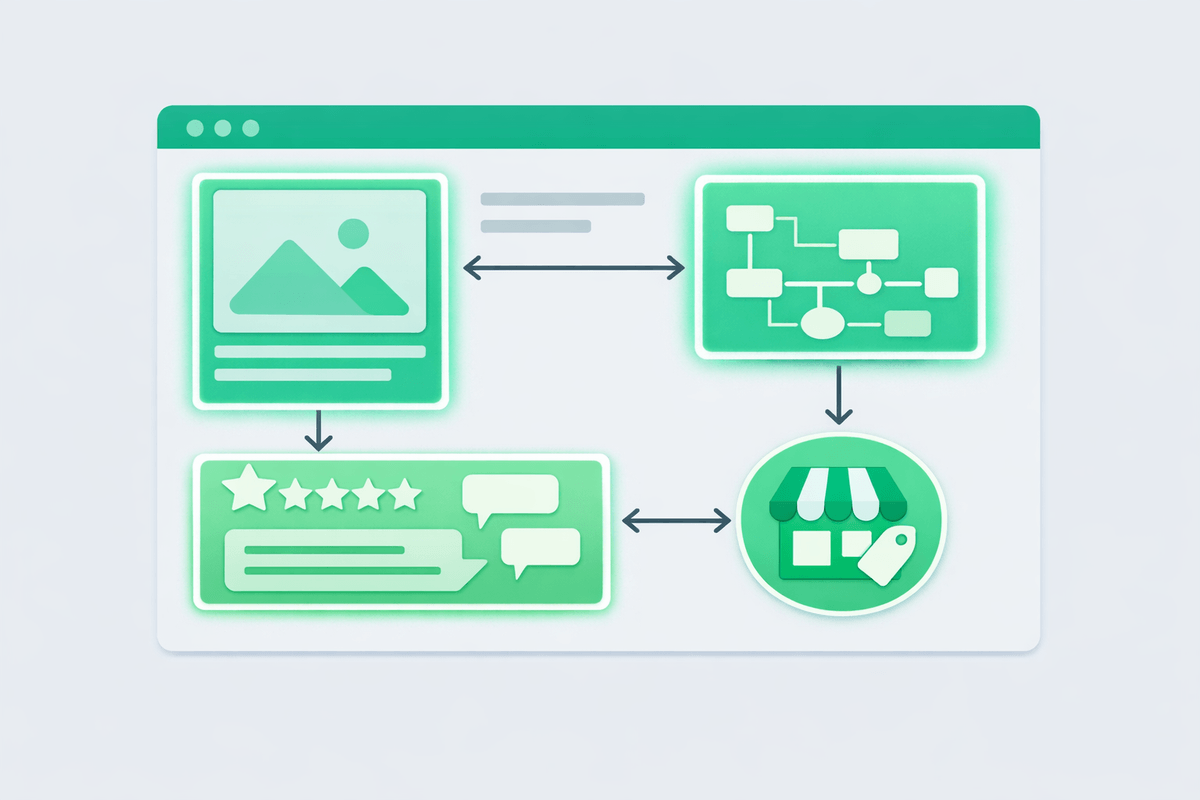
Technical GEO succeeds when structured data matches visible page copy and real inventory. Product schema (Schema.org Product, the markup that describes a product) helps machines read attributes; Review schema (Schema.org Review, the markup for ratings and reviews) helps validate sentiment; FAQPage schema (Schema.org FAQPage, Q&A markup) helps extract shopper questions; Google Merchant Center (Google’s product feed platform) keeps pricing and availability consistent across Google surfaces.
Product Schema
Implement comprehensive product schema including:
- Name, description, brand
- Price and availability
- Reviews and ratings (aggregated properly)
- SKU and product identifiers
- High-quality images
Rich Content Requirements
| Element | Why It Matters |
|---|---|
| High-quality images | AI may reference visual quality in recommendations |
| Video demonstrations | Builds trust and engagement signals |
| 360-degree views | Particularly important for fashion, furniture |
| Size/fit guides | Essential for apparel, reduces returns, builds trust |
Site Performance
- Fast page loads (max 3 seconds)
- Full mobile optimization
- Clean, intuitive navigation
- Easy-to-find product information
Troubleshooting: why AI recommends the wrong product
- Schema errors: Product schema fails validation or omits variant SKUs; fix in Shopify or WooCommerce templates and re-test.
- Feed mismatches: Google Merchant Center price/availability differs from on-page copy; align update frequency and canonical URLs.
- Missing review markup: Ratings exist visually but aren’t machine-readable; add Review schema or a supported reviews app.
For official implementation details, reference Schema.org vocabulary (Zeo overview and examples) and Google-focused guidance on feeds and AI shopping surfaces (BigCommerce, 2026).
How GEO Changes by E-commerce Category
One GEO template does not fit every category because AI assistants weigh different decision factors. Apparel needs fit certainty; electronics need compatibility certainty; supplements are YMYL-adjacent (Your Money or Your Life, categories where safety claims require higher trust). Recommendation eligibility rises when category-specific “deal-breaker info” is explicit and consistent across the page, reviews, and feeds.

| Category | AI decision factors | Content needed | Trust signals | Common GEO risk |
|---|---|---|---|---|
| Apparel | Fit, returns, materials | Size/fit guide, fabric specs | UGC photos, return clarity | Variant confusion |
| Beauty | Ingredients, skin concerns | Ingredient list, use guidance | Before/after + reviews | Vague claims |
| Electronics | Compatibility, warranty | Ports, OS, model fit | Spec accuracy + support | Outdated models |
| Home goods | Dimensions, assembly | Measurements, install steps | Video demos + Q&A | Missing dimensions |
| Supplements | Safety, compliance | Label facts, warnings | Conservative wording | Regulatory exposure |
| Luxury | Authenticity, provenance | Materials, origin, care | Authentication policy | Trust deficit |
Retail patterns reinforce this: enriched feeds and consistent attributes are repeatedly cited as core to AI-powered product representation (BigCommerce, 2026: Ecommerce GEO in 2026). For regulated categories (e.g., supplements), avoid medical promises and prioritize verifiable label facts.
What ROI E-commerce Brands Can Expect from GEO
GEO ROI usually shows up first as visibility and assisted revenue, not clean last-click conversions—because shoppers often research in ChatGPT or Perplexity and purchase later via direct, email, or marketplace. Use conservative benchmarks and measure what you can control: recommendation presence, citation share, and product inclusion rate.
| Initiative | Typical cost input | Expected outcome | Window | Leading indicator |
|---|---|---|---|---|
| Top-SKU content upgrade | 1–3 hrs/SKU | More eligible prompts | 30–60 days | Product inclusion rate |
| Review acquisition program | Ops + incentives policy | Higher trust + CTR | 60–90 days | Review-source diversity |
| Buying guide library | 2–6 pages/month | More citations | 60–120 days | Citation share by query |
| Schema + feed alignment | Dev sprint (1–2 wks) | Fewer wrong recs | 30–90 days | Price/stock consistency |
| Product video rollout | 1–2 hrs/video + edit | Higher confidence | 60–120 days | Video engagement |
Illustrative benchmark model (not a guarantee): teams often see measurable improvement in “recommended on priority prompts” within 60–90 days when they start with high-margin product clusters and fix inventory/price consistency first. For broader context on AI product discovery shifts, see Authority AI (GEO + AEO for E-Commerce).
How to Measure E-commerce GEO Success
Measure GEO like a system: visibility (are you showing up), retrieval (can assistants fetch correct info), trust (do assistants cite credible sources), and revenue (is it influencing sales). Use a prompt library per category and re-test weekly because AI answers rotate and citations change.
| Metric | Definition | 30/60/90-day benchmark | Business meaning |
|---|---|---|---|
| AI citation share | % of tracked prompts citing your brand | 1–3% / 3–7% / 5–12% | Authority + eligibility |
| Product recommendation presence | % prompts where a SKU is recommended | 2–5% / 5–10% / 8–15% | Demand capture |
| Query coverage | # distinct use cases covered | +10 / +25 / +40 | Fan-out resilience |
| Review-source inclusion | Prompts referencing 2+ review sources | Low / Medium / High | Trust compounding |
| Assisted revenue | Revenue influenced by AI journeys | Directional / trending / stable | ROI validation |
Implement measurement in Google Analytics 4 (GA4) and Looker Studio with channel groupings for AI referrals, but expect attribution gaps: many AI journeys are “research now, buy later.” Pair analytics with tracking AI citations to measure GEO success so visibility improvements don’t get lost when last-click undercounts impact.
Common E-commerce GEO Mistakes That Block AI Recommendations
AI recommendations fail for predictable reasons: weak data, weak trust, or content that’s hard to extract. Fixing these issues usually unlocks more recommendation prompts faster than publishing net-new content.
| Mistake | Impact | Fix |
|---|---|---|
| Thin product descriptions | AI can’t confidently recommend | Add comprehensive details, benefits, use cases |
| Ignoring reviews | Products without reviews don’t get cited | Build review solicitation program |
| Missing comparison content | Competitors fill the gap | Create fair, balanced comparison guides |
| Outdated information | Wrong prices/availability damages trust | Implement regular content audits |
| Over-optimization | Spammy content gets filtered | Write for humans, structure for AI |
Troubleshooting examples: (1) a Shopify variant page gets recommended instead of the canonical product—fix canonical URLs and variant schema; (2) Perplexity cites an old price—tighten feed refresh and on-page price visibility; (3) ChatGPT ignores a SKU—add third-party review presence (e.g., Trustpilot where relevant) and a clearer 40–75 word summary.
90-Day GEO Implementation Roadmap for E-commerce Teams
GEO implementation moves fastest when you start with high-volume and high-margin product clusters, then expand to category hubs and comparison content. Assign owners early: SEO, Content, Engineering, and Merchandising each control different recommendation signals.
This Week: Audit and Baseline
- SEO: Test product queries in ChatGPT and Perplexity
- Merchandising: Document what competitors are being recommended
- Content: Identify top products with thin descriptions
- SEO/Ops: Check current review presence across platforms
This Month: Quick Wins
- Content: Enhance descriptions for top 20% of products
- Engineering: Implement product schema site-wide
- Content: Create one buying guide for a key category
- Ops: Launch review solicitation campaign
This Quarter: Build Out
- Content: Build comprehensive buying guide content library
- SEO: Ensure presence on key comparison sites
- Content: Create comparison content for top competitors
- Analytics: Track and optimize based on results
Ongoing: Maintain and Expand
- Merchandising: Update product content as inventory changes
- Content: Refresh guides with new products and prices
- SEO: Monitor AI citations weekly
- Growth: Expand to new product categories
If Google is a primary revenue channel, add strategies to appear in Google AI Mode search results to the technical backlog alongside schema and feed hygiene.
Where AI Commerce Is Heading in 2026
AI commerce is shifting from “ranking pages” to “selecting products.” Two signals matter more each quarter: (1) fresh, verifiable commerce data and (2) multimodal proof (images + video + reviews). BigCommerce notes that product feeds and attribute consistency are core to how AI engines represent brands (2026, BigCommerce). In Google’s AI ecosystem, YouTube is the #1 cited domain at 23.3% of citations (Surfer AI Tracker, Aug 2025, cited by BigCommerce), which makes product demos and explainers a direct visibility lever.
“AI models punish hallucination—recommending an out-of-stock product destroys user trust. Therefore, implementing Dynamic Inventory Streaming via the ItemAvailability schema is critical. Unlike static SEO, GEO requires live data feeds that allow an AI agent to verify stock status in milliseconds.”
| 2026 trend | What changed | What e-commerce teams should do |
|---|---|---|
| Recommendation-first discovery | Assistants answer with short lists | Optimize for eligibility signals |
| Higher freshness expectations | Old prices break trust | Align feeds + on-page copy |
| Video as a trust primitive | YouTube citations dominate Google AI | Publish demos + how-tos |
| Community validation | Forums influence trust | Earn reviews + mentions |
The practical implication: build a system that stays accurate (pricing/stock), earns trust (reviews), and explains decisions (guides + video). Optimizing for only one assistant is fragile; optimizing for retrievability and trust is durable.
The Bottom Line: E-commerce Brands Need GEO Before AI Shopping Behavior Hardens
AI is now a primary product discovery channel, and recommendation slots are limited. If products are not retrievable, verifiable, and citable, competitors will be recommended instead—often before a shopper ever reaches a search results page.
Traffic to retail sites from generative AI sources grew over 1,200% in the last year (Adobe Analytics, cited in Flatline Agency, 2025: Flatline Agency), and Google AI Overviews increasingly cite sources outside the top-10 results (Ahrefs/BrightEdge, Feb 2026, cited by BigCommerce: BigCommerce). That combination makes GEO a near-term competitive advantage.
Next step: pick one category, build a prompt library, upgrade the top SKUs (specs, reviews, schema, video), and track recommendation presence across ChatGPT, Perplexity, Gemini, and Google AI Overviews. Oltre AI can help teams monitor visibility and close gaps, but the fundamentals are implementable starting this week.
FAQ: E-commerce GEO Questions Brands Ask Most
How much does GEO for e-commerce typically cost?
GEO costs are mostly labor: content updates, review programs, and engineering time for Schema.org and feed alignment. Many teams start with 1–2 engineering weeks plus ongoing content (2–6 guides/month). The most cost-effective approach is prioritizing the top revenue SKUs and one category hub first.
How long does it take to see products recommended in ChatGPT or Perplexity?
Most brands see early movement in 30–60 days when they fix thin product pages, add clear summaries, and improve review coverage. More durable gains (consistent citations and “best for” inclusion) typically take 60–90 days because assistants need enough corroborating signals across pages, reviews, and feeds.
Do I need to rank #1 on Google for GEO to work?
No. AI systems often cite sources that are not top-ranked for a single keyword, especially in Google AI Overviews. Ahrefs/BrightEdge data cited by BigCommerce reports only 17–38% of AI Overview citations come from top-10 organic results (Feb 2026), so completeness and trust can win even without #1 rankings.
What’s the minimum schema markup required for AI product recommendations?
The minimum is Product schema (name, brand, price, availability, identifiers) plus correctly implemented aggregate rating/reviews when available. For categories with frequent questions, FAQPage schema can improve extraction. Schema helps, but it must match visible on-page copy and real inventory to prevent wrong recommendations.
Why does an AI assistant recommend the wrong price or an out-of-stock item?
Wrong recommendations usually come from stale feeds, inconsistent canonical URLs, or schema that doesn’t reflect variants and availability. Fix by aligning Google Merchant Center (or equivalent feeds) with on-page pricing, refreshing inventory more often, and validating Schema.org markup. Consistency is the fastest way to restore trust.