
Google AI Mode Optimization: How to Win Conversational Search in 2026
By Luca Pizzola, Co-Founder of Oltre.ai
Last updated: March 2026
Google AI Mode optimization is the practice of structuring content so Google’s conversational interface can retrieve, synthesize, and cite it across multi-turn answers. Winning in AI Mode requires coverage for query fan-out subtopics, entity-rich sections that stand alone, and commerce/local data readiness—not just traditional keyword rankings.

What Is Google AI Mode Optimization?
Google AI Mode optimization means making pages easy for Google AI Mode (Google’s opt-in conversational search experience in Google Search) to cite during multi-turn conversations. It is not the same as “ranking #1” for blue links because AI Mode uses query fan-out (Google’s technique for splitting one question into many sub-queries) and then synthesizes answers from multiple sources.
AI Mode behaves like a distinct citation ecosystem. Only 13.7% of citations overlap between Google AI Mode and Google AI Overviews (Ahrefs, Dec 2025), and AI Mode averages 12.6 links per response (SE Ranking, Feb 2026). For brands, visibility often matters more than clicks: AI Mode has a 93% zero-click rate (Yotpo, 2026). That is why “citation-first” content—self-contained sections, clear definitions, and structured comparisons—wins.
Google AI Mode (functionally similar to using Gemini Advanced or a dedicated “AI” tab) is a “walled garden” distinct from the traditional SERP, designed for “query fan-out," encouraging users to break one complex problem into multiple sub-questions without ever leaving the chat interface.
Next: a practical comparison of AI Mode, AI Overviews, and traditional SEO so teams know what to keep—and what to change.

Google AI Mode vs. AI Overviews vs. Traditional SEO
Google AI Mode, Google AI Overviews, and traditional SEO share the same underlying index (Google Search), but they reward different content behaviors. AI Mode is built for extended exploration, AI Overviews for quick summaries, and traditional SEO for ranked lists of links. The result: ranking well can help, but it does not guarantee citations in AI Mode.
| Aspect | Google AI Mode | Google AI Overviews | Traditional SEO | Source (date) |
|---|---|---|---|---|
| Experience | Opt-in, multi-turn chat | Automatic summary block | 10 blue links + SERP features | Evertune AI (2025) |
| Retrieval behavior | Fan-out + synthesis | Fan-out + summary | Single-query ranking | Yotpo (2026) |
| Top-10 overlap | ~54% domains, ~35% URLs | Varies by query | 100% by definition | Semrush (2026) |
| Citation overlap | 13.7% vs Overviews | 13.7% vs AI Mode | N/A | Ahrefs (Dec 2025) |
| Click behavior | 93% zero-click | 43% zero-click | 34% zero-click | Yotpo (2026) |
What changes for marketers: AI Mode demands semantic completeness, entity density, and follow-up readiness. Only 14% of URLs cited by AI Mode rank in the organic top 10 (SE Ranking, Aug 2025), so “keyword-only” SEO misses fan-out discovery.
What stays the same: technical hygiene, crawlability, and credible sourcing still matter. What must be added: modular sections designed to be extracted and cited. For a broader framing, see comparing geo-targeting and traditional SEO and our guidance on appearing in Google AI Overviews.

How Query Fan-Out Works in Google AI Mode
Query fan-out is the technology that makes AI Mode search deeper than traditional Google. In practice, AI Mode behaves like retrieval-augmented generation (RAG) (a method where an AI model retrieves documents before generating an answer) layered on top of Google’s index and data systems.
The Process
- User submits a complex question
- AI Mode breaks it into subtopics and related queries
- Multiple searches run simultaneously across different data sources
- Results are synthesized into a comprehensive answer
- User can ask follow-ups, which trigger additional fan-out
What This Means for GEO
Traditional SEO targets single queries. Query fan-out means your content might be discovered through related subtopic searches you never explicitly targeted.
Example: A user asks "What's the best CRM for a 50-person sales team?"
AI Mode might fan out to:
- "CRM features for mid-size sales teams"
- "CRM pricing comparison 2025"
- "CRM integrations with sales tools"
- "CRM implementation timeline"
Content that covers multiple angles of a topic has more opportunities to be cited across these parallel searches. Surfer SEO found pages ranking across multiple fan-out sub-queries can see a +161% citation boost versus pages focused on a single query (Surfer SEO, Dec 2025). Each H2 should answer a distinct sub-intent so AI Mode can cite it cleanly.

Optimization Strategies for Conversational Search
1. Create Comprehensive Topic Coverage
AI Mode rewards pages that cover a topic end-to-end, because multi-turn conversations naturally expand scope. A thin page that answers one narrow question is less likely to be reused when the user asks follow-ups in Gemini (Google’s LLM family), ChatGPT, or Perplexity.
- Cover topics from multiple angles in single resources
- Include sections that address common follow-up questions
- Provide both overview information and detailed specifics
- Link related concepts within your content
2. Anticipate Follow-Up Questions
Conversational search optimization starts by predicting the next question, not just the first one. In AI Mode, users spend longer per query—average session duration is reported as 3× longer than traditional search (Yotpo, 2026)—so follow-ups are the default behavior.
- "How does this compare to X?"
- "What are the specific steps?"
- "What does this cost?"
- "How long does this take?"
- "What are the risks or downsides?"
3. Structure for Multi-Query Discovery
Multi-query discovery improves when each section is independently citable. That means question-like headings, 120–180 word modules, and inline definitions for entities like Google Search Console (Google’s performance reporting tool) and Schema.org (the structured data standard).
- Clear headings that match likely subtopic queries
- Self-contained sections with complete answers
- Internal navigation that helps both users and AI understand relationships
- Summaries that capture key points from each section
4. Support Comparison Queries
AI Mode users frequently ask comparative questions, so neutral comparisons outperform one-sided sales copy. Semrush found 92% of AI Mode responses show sidebar linking with about 7 unique domains (Semrush, 2026), so being “one of the cited sources” is the goal.
- Acknowledge competitor strengths
- Provide specific, factual differentiators
- Include relevant criteria for decision-making
- Present information neutrally
5. Include Actionable Next Steps
AI Mode is moving toward agentic actions (shopping, booking, tasks), so content that includes steps, requirements, and “what to do next” aligns with where Google is going.
- Step-by-step instructions
- Clear calls to action
- Contact information and booking links
- Integration with Google Business Profile
AI SEO expands this to include conversational prompts that users ask AI tools. AI can interpret many rephrasings by using “query fan-outs” to run related searches, so AI SEO involves mapping topics and long-tail keywords to natural language queries.
| High-impact lever | What to change on-page | Why AI Mode cares |
|---|---|---|
| Semantic completeness | Answer + steps + constraints | Better synthesis for follow-ups |
| Entity density | Define tools, standards, brands | Clearer retrieval targets |
| Comparison blocks | Tables, pros/cons, “best for” | Matches decision queries |
| Freshness cues | Visible update date + dated stats | Recency-weighted selection |
Oltre AI practitioner note: In audits, the fastest wins usually come from rewriting only the “money sections” (pricing, setup, limitations, alternatives) into standalone modules—then adding one comparison table. That combination tends to create new fan-out entry points without rewriting the entire site.
- Pick 10 priority queries and list 8–12 likely follow-ups for each.
- Create or retrofit one page per topic with modular sections and one table.
- Add dated stats and definitions, then re-test in AI Mode monthly.
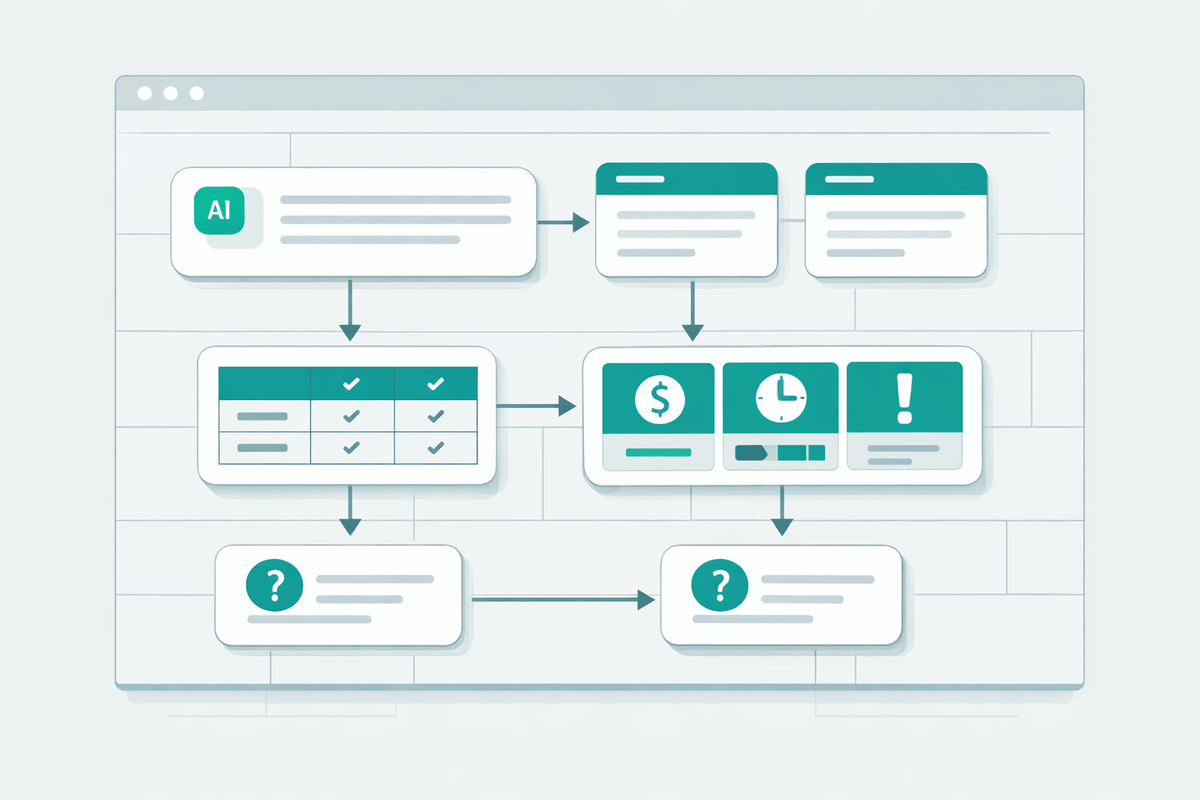
How to Structure Content for Follow-Up Queries
AI Mode rewards pages that answer the first question and the likely next question in the same document. Multi-turn conversations mean the model keeps expanding the scope (cost, timing, alternatives, troubleshooting), so formatting must make those answers easy to extract as standalone chunks.
A brand that ranks on page one for competitive keywords may not appear in AI Overviews at all. A brand with modest traditional SEO performance might consistently appear in AI Mode responses because its content is structured in a way that AI models find authoritative and easy to synthesize.
Operational rules that consistently improve extractability: use question-based H2s, keep sections around 120–180 words, and front-load the direct answer. For broader AI ecosystems, Kevin Indig’s Growth Memo analysis found 44.2% of ChatGPT citations come from the first 30% of content (Growth Memo, Feb 2026), which is a useful heuristic for AI Mode too.
| Section type | Purpose in AI Mode | Example heading |
|---|---|---|
| Definition | Anchor the entity | “What is Google AI Mode optimization?” |
| Process | Explain “how it works” | “How query fan-out works in AI Mode” |
| Comparison | Answer “vs” questions | “AI Mode vs AI Overviews vs SEO” |
| Decision details | Handle follow-ups | “Cost, timeline, risks, limits” |
| FAQ | Capture long-tail prompts | “FAQ: Google AI Mode optimization” |
Use FAQPage schema (structured FAQ markup) and HowTo schema (step markup) where appropriate, and define entities inline (for example: “Google Merchant Center (product feed platform)”).

How Google AI Mode Shapes Commerce and Local Discovery
Google AI Mode is increasingly commerce-aware: it answers “what should I buy?” and “who should I book?” with synthesized recommendations. That makes agentic search (AI that helps complete tasks, not just find info) a practical optimization target for e-commerce and local businesses.
For product discovery, AI Mode can rely on systems like the Google Shopping Graph (Google’s product knowledge system), Google Merchant Center (product feed management), and Google Pay (payments and checkout). For local discovery, AI Mode leans on Google Business Profile (local listing management), Google Maps (local index), and review signals. Users also verify: 37% of users start discovery in an AI tool but return to Google to confirm facts and prices (Yotpo, 2026).
E-commerce example: “Best running shoes for flat feet under $150” often triggers follow-ups like sizing, returns, and availability. Pages with explicit constraints (price, fit, shipping) and clean Product/Offer markup are easier to cite. See our geo-targeting strategies for e-commerce for merchandising-focused GEO patterns.
Local example: “Best dentist near me for Invisalign” can fan out into insurance, appointment availability, and reviews. Keep categories, hours, services, photos, and attributes current in Google Business Profile, and encourage detailed reviews that mention specific services.
Technical Implementation and Citation Tracking
Technical implementation for AI Mode starts with crawlable content and structured data. Use Schema.org (the standard vocabulary for structured data) to clarify relationships between entities like products, locations, authors, and FAQs. Also prioritize mobile performance: AI Mode is often used on phones, and slower pages reduce engagement and downstream conversions.
Required Technical Elements
Structured data. Implement schema markup appropriate to your content type. AI Mode uses structured data to understand content relationships and surface appropriate results.
Mobile optimization. AI Mode is designed for conversational interaction, often on mobile devices. Responsive design and fast load times are essential.
Content accessibility. Avoid hiding content behind tabs, accordions, or JavaScript that might prevent AI from accessing complete information.
Recommended Schema Types
| Use Case | Schema Type |
|---|---|
| Products | Product, Offer |
| Services | Service, LocalBusiness |
| How-to content | HowTo |
| FAQs | FAQPage |
| Articles | Article with author |
| Events | Event |
| Schema type | Likely AI Mode value | Best for | Source (context) |
|---|---|---|---|
| FAQPage | High | Follow-up prompts | Relixir/industry tests (2025–2026) |
| HowTo | High | Steps + prerequisites | Google rich results ecosystem |
| Product + Offer | High | Price/availability answers | Merchant Center feeds |
| LocalBusiness | High | Near-me + service queries | Google Maps/GBP |
| Article | Medium | Authorship + freshness | E-E-A-T signals |
| VideoObject | Medium–High | Demos + tutorials | YouTube prominence in Google AI |
How to track AI Mode citations (directionally)
AI Mode measurement is directional, not deterministic, because citations can rotate between runs. Still, teams can track progress with a consistent methodology: (1) prompt sampling in AI Mode for a fixed query set, (2) brand mention monitoring, (3) Google Search Console trend analysis, and (4) assisted conversion tracking in analytics.
- Prompt testing: run the same 20–50 queries monthly; record cited domains and follow-up paths.
- Search Console: watch branded query lift and long-tail impressions (AI Mode traffic is not separately segmented).
- Server logs: look for unusual referrers and spikes aligned to tests.
- Monitoring: use AI citation tracking techniques and cross-engine checks (ChatGPT, Perplexity, Gemini) to validate entity visibility. For ChatGPT-specific patterns, see methods to get cited by ChatGPT.
A simple implementation workflow
- Choose one topic page and add an answer capsule + 6–8 question-based H2s.
- Add one comparison table and one “cost/timeline/limitations” block.
- Implement FAQPage + relevant schema (Product, LocalBusiness, HowTo).
- Update at least one dated statistic each quarter and re-test in AI Mode.
Monitor Your AI Mode Visibility
Oltre.ai tracks your brand's appearance across Google AI Mode, AI Overviews, and the broader Gemini ecosystem. Understand how conversational search impacts your visibility and optimize accordingly.
Related reading: generative engine optimization strategies and geo-targeting for B2B marketing.
FAQ: Google AI Mode Optimization
How is Google AI Mode optimization different from SEO?
Google AI Mode optimization focuses on being retrieved and cited inside multi-turn answers, not just ranking for a single query. Because only about 14% of AI Mode-cited URLs rank in Google’s top 10 (SE Ranking, Aug 2025), teams need modular sections, clear entity definitions, and follow-up coverage in addition to classic SEO.
How much does AI Mode optimization cost to implement?
Most teams can start with a low-cost content retrofit: add an answer capsule, 6–8 question-based sections, one comparison table, and FAQPage schema to an existing page. The main cost is editorial and technical time, plus optional tooling for monitoring citations and brand mentions across AI engines.
How long does it take to see citations in AI Mode?
Expect weeks, not days. After updating content structure and schema, visibility depends on crawl and index refresh plus citation rotation. A practical benchmark is to re-test a fixed query set monthly for 2–3 cycles, tracking whether citations appear in the first answer and in common follow-up turns.
Why isn’t my content being cited in Google AI Mode?
The most common causes are thin coverage (no answers for follow-ups), weak entity clarity (no definitions for tools, standards, or products), and missing structured data. AI Mode also behaves differently from top-10 rankings, so a page can rank well but still be skipped if another source is easier to synthesize.
Does local SEO still matter for AI Mode?
Yes. AI Mode frequently synthesizes local recommendations using Google Business Profile data, Google Maps signals, and review content. Keeping categories, hours, services, and photos current—and earning detailed reviews—improves the chance that AI Mode can confidently recommend and cite a local entity for “near me” follow-ups.